Additional Text (A): Staatsexamen Frühjahr 2004
A
key aspect of the 'post-Catholic' Ireland agenda is the insistent blackening of
every element of Catholic Ireland's past. The entire history of our country is
now painted as though darkly governed by a hooded Inquisition of priests and
cross-bearing bishops who treated politicians like puppets, regarding the
populace as moral serfs and dominating everything they touched by a form of
terror. It will be noticed that De Valera1 is demonized at every turn
- the portrayal of Dev as a devious hypocrite and probable assassin of Collins
was deliberately crafted by Neil Jordan, a strong 'post-Catholic Ireland' man -
because Dev is now associated with that Catholic Irish past in which everything
was so grim and 'repressive'.
The
true picture of Catholic Ireland in the past is that the Church was most
ardently, most passionately and most fiercely supported and defended by the
people, that the politicians curried favour shamelessly with bishops whenever
they could for the same cynical reasons that they now curry favour with Brussels
- because they reckoned it meant votes, and thus power and revenue, and that
such 'repressive' aspects of the past as literary censorship were not led
primarily by priests, but by little old ladies on library committees who, in
their thousands, submitted books to the Censorship Board demanding that these
not be available in the public realm. […]
One
of the commonest calumnies about Catholic Ireland in the past was that the
Church was so obsessed with sexual prohibitions that it preached on nothing else.
This is utter baloney [...] They preached vehemently against crime and behaving
dishonestly, and ever underlined the importance of acting justly in trading and
working exchanges. [...]
Not coincidentally, I think, one of the most salient aspects of 'post-Catholic Ireland' now is an alarming rise in crime - and murder - and the disappearance, in the countryside, of that trust and openness which used to be characteristic of rural Ireland.
Spirituality among the Irish is always strong, but it is a free-floating spirituality now, settling on everything from Buddhism to Scientology to New Age crystal-gazing and tree-hugging. Whether the Catholic Church in Ireland can compete with these new forms of faith - let alone compete with the consumerism and the political power that has taken its place - must, I suppose, depend upon the Holy Spirit eventually. But sociologically speaking, no system which has lost its confidence can survive, and I think the saddest thing of all is that Catholicism in Ireland has totally lost its confidence, its nerve, its belief in itself and its affirmation of its own values.
(Mary Kenny, article in the Catholic Herold, repr. in the Independent,
13 March 1997; repr. in Patricia Craig, ed. The Oxford Book of
Ireland.
Oxford and New York: OUP, 1998. 496f. - adapted -)
1 De Valera, Eamon, nickname Dev, who originally fought
together with Michael Collins for the establishment of the Irish
Republic; later statesman,
prime minister, and President. (Nicht zu übersetzen!)
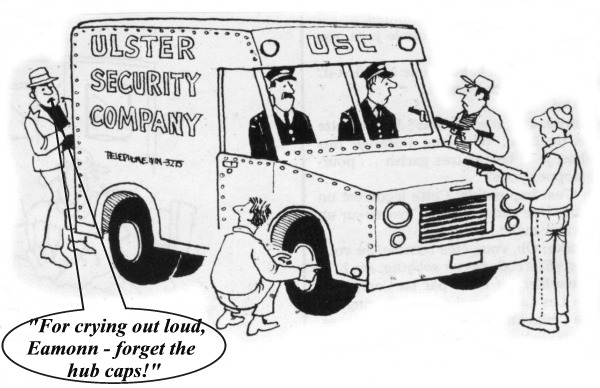
CARTOON
back to Texterschließung SS 2006, index model answer: AFTER Klausur!
THE BOTTOM LINE THE BOTTOM LINE THE BOTTOM LINE THE BOTTOM LINE THE BOTTOM LINE THE BOTTOM LINE THE BOTTOM LINE