WS 2005/2006 Preuß Texterschließung Staatsexamen Frühjahr 2002: text 7
The New World had a profound impact on the quality of
European life and the shape of European thought. To some observers it was a raw
and barbarous place requiring the civilizing hand of European man; others
pronounced it virgin and unspoiled, a land of purity, youth, and innocence,
where man might be remade. All, however, were very nearly mesmerized by it. From
the Halls of Montezuma to the Kingdom of the Saguenay it seemed a fabulous place,
its treasure and potential far exceeding anything to be found in the world they
knew.
In time many commentators found its incredible promise most fully
realized in the United States. There liberty and abundance had combined to
produce a spectacularly successful civilization, one committed to, and
apparently able to sustain, a society of opportunity and freedom for all. With
the making of a successful revolution, the special virtues of American society
came to be viewed not simply äs an emanation of place but as a function of
politics, for the republican order seemed simultaneously to confirm and amplify
American freedoms. American political and social principles, it was thought,
would redeem Europe from the lassitude of aristocratic domination.
If much of the American impact on the European world before 1900
occurred at the level of idea and Inspiration, the imperialism of the 1890s
joined with Theodore Roosevelt's aggressive foreign policy to transform
America's presence in the world affairs into one which was hard, tangible, and
real. European observers noted with concern the rise of this new constellation
in the heavens of their world. "One hears," wrote the French historian
Henri Hauser in 1905, "nothing spoken of in the press, at meetings, in
parliament, except the American peril."
The
emergence of America turned, of course, on more than the war with Spain or the
antics of an exuberant chief executive*); its foundations rested upon America's
maturing economic order, the rise of modern Communications, and a mastery of
organization. These elements combined with the appeal of American popular
culture to ensure a massive American influence abroad. American business
techniques, organizational principles, machinery, magazines, dress, sports,
slang, capital, and values were making their way around the world. They were at
once altering the style of the globe and making it tributary to the United
States.
(Allan Smith, "Introduction" to: Samuel E. Moffett, The Americanization of Canada. University of Toronto Pr., 1972).
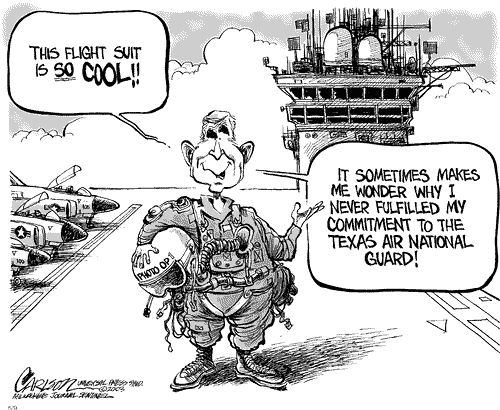
AMERICARTOON**),
by Stuart Carlson, May 9,
2003:
*)
"The antics
of an exuberant chief executive"
back to Texterschließung WS 2005/2006, index **)more AMERICARTOONS back to homepage
THE BOTTOM LINE THE BOTTOM LINE THE BOTTOM LINE THE BOTTOM LINE THE BOTTOM LINE THE BOTTOM LINE THE BOTTOM LINE