
WS 2005/2006 Preuß Texterschließung
Staatsexamen Herbst 1981: Text 2Detective fiction, this strange child of Edgar Allan Poe, has since its birth been acclaimed by a wide and avid following, boasting addicts matched only by a stranger child - science fiction. Addiction is a leveler. Economic and social barriers are circumvented by both detective and science fiction, attracting the rising and the risen and the set, intellectuals and non-intellectuals. It would seem that both genres fulfill the need and expectations of the modern reader ……
Perhaps one of the reasons the detective has become a familiar example of the modern hero is that, unlike many other contemporary protagonists, he can move easily between the various economic and social levels in an increasingly stratified and complex society. Although we are surely the most mobile people ever to inhabit the earth, our lives are as much pigeon-holed by this mobility as expanded by it. We can travel from Alaska to Tierra del Fuego without leaving the family camper; motels everywhere seem designed to achieve that blandness which is readily taken for familiarity; the suburbs of Atlanta, Georgia look indistinguishable from those of Columbus, Ohio. The detective shares our mobility; yet at the same time he is allowed access to the various physical and psychological cubicles in which so many of us lead our lives - the office, the apartment, the car. His role requires that he meet people on a personal, in some ways intimate, basis, that he probe their pasts and possible sins, that he evaluate their character, and that he do these things in a relatively unrestricted manner, moving from townhouse to country cottage, from Hollywood to Watts. Put another way, the detective enacts the fantasies that our insular mobility denies us.
The same civilization that creates our wide access to space, and the paradoxical contraction that often accompanies this access, causes us to prize time while we squander it, to seek clarity as we rapidly displace the future. In the twentieth century many writers have made increasing demands on the reader, shunting from the novel of social interaction to the novel of interior consciousness, from the structure of plot to the structure of theme and idea, from mature characters of some repose to the fragmentations of the anti-hero. These emphases place a heavy burden on the reader, even the determined and intelligent reader. The detective story meets this sometimes difficult fiction with relatively simple language, intricate plots, sound characterizations, and examples of how a rational mind can decipher truths through the use of logic.
From D. Allen/D. Chacko ed., Detective Fiction. Crime and Compromise, New York 1974
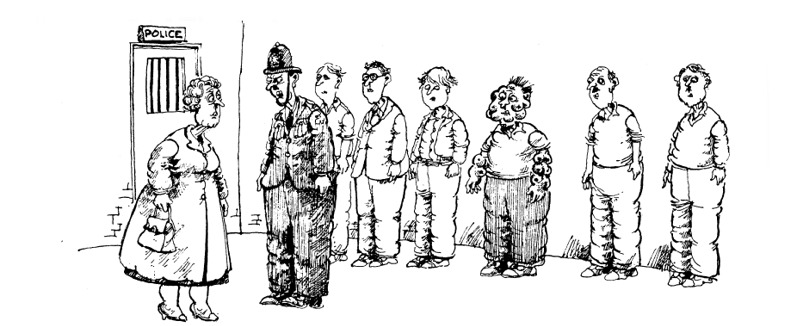
CRIME AND CRIME AGAIN (1) click for more crime cartoons
back to Texterschließung WS 2005/2006, index back to homepage
THE BOTTOM LINE THE BOTTOM LINE THE BOTTOM LINE THE BOTTOM LINE THE BOTTOM LINE THE BOTTOM LINE THE BOTTOM LINE