WS 2009/2010 Preuß
Examen Übersetzung E – D MOCK
EXAM (22/12/2009)
(=
Staatsexamen Frühjahr 2008)
Text 9
? Please, translate the boxed-in passage into idiomatic
German >
Alongside unhelpful images and memories, Britain experienced in the
1980s and 1990s more open anti-German prejudice among her rulers than at any
time since 1945. Within the broader aim of reasserting Britain internationally,
Margaret Thatcher*) and some of her senior
ministers harboured deep personal suspicion of everything German.
Though these were mainly open secrets to be deduced
from their pronouncements, in 1989-92 they erupted to the surface. Unlike
near-contemporaries who themselves had fought against Germany and come back
keen to ensure that no such war should ever happen again, Thatcher never got
over the experience of being a civilian threatened by the Luftwaffe.
As Prime Minister she was constantly amazed that those
around her did not share her views and sought advisers who did, notably her
private secretary Charles Powell. When consulting historians chosen for their
expertise on post-war Germany, she lectured them on what they ought to be
advising her to do, generally what she already intended; [...] Challenged for
her views, she announced that she did not believe in “national guilt”,
adding, “but I do believe in national character”.
Reminded of the size of Germany’s contribution to
the EU budget, she responded, “it’s always been a misnomer to say that the
Germans are the paymasters of Europe. The Germans have been simply paying
reparations for all the things they did during the war.” Nor was she
comforted by West Germany’s economic strength, which had sustained democracy
since 1945, for she “never believed that German nationalism was dead”;
younger Germans were sure to seek reunification and make their country again
the dominant force in Europe. [...] She was unlucky therefore to be the
premier who was forced to carry out the pledge to support the reunification of
Germany given by her post-war predecessors [...].
Struggling to obstruct the process, she argued like the victors of 1945
that German unity was simply too big an issue to be decided by Germans for
themselves, but received backing of consequence from nobody who mattered. When
Russia, America and France all accepted German unity, she had little option but
to recognize what had happened, but even then assented only when assured that
“sizable” British, French and American forces would remain on German soil,
to contain not a Soviet threat but a hypothetical German one. This was, as she
put it in her memoirs, “one instance in which a foreign policy I pursued met
with unambiguous failure”.
Quelle: John Ramsden, Don
't Mention the War: The British and the Germans since 1890. London
2007: S. 402-405.
for a longer passage click HERE
Don't Mention the War, SPECIAL (Ramsden)
Fawlty Towers: “The Germans”: a) (excerpt) www.spike.com/video/fawlty-towers-dont/2795405
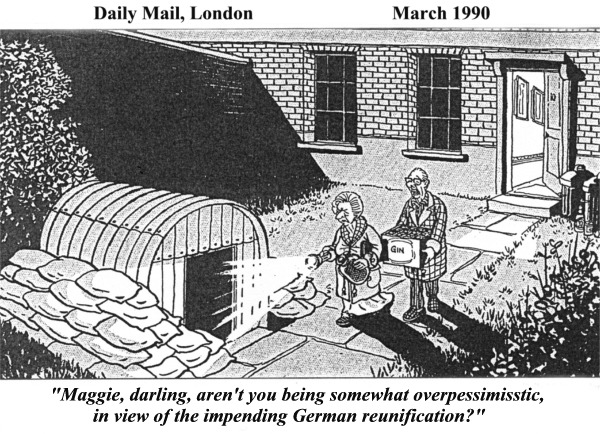
*) CARTOON
CHRI$TMA$
GOODIES GALORE: www.wepsite.de/Christmas.htm
Wishing you a COOL YULE and A FESTIVE FIRST, W.E.P.
back to exam translation WS 2009/2010, index back to homepage
THE BOTTOM LINE THE BOTTOM LINE THE BOTTOM LINE THE BOTTOM LINE THE BOTTOM LINE THE BOTTOM LINE THE BOTTOM LINE