WS 2008/2009 Preuß Texterschließung (Staatsexamen Herbst 2007) Text 13
Call
it the inverse law of US presidential obituaries: the greater the acclaim for
the president in his day, the harsher the reappraisals of his record after his
death. Ronald Reagan, so popular in office that his supporters discussed
repealing the 22nd amendment to the constitution that limits presidents to
serving two terms, received a downbeat, critical farewell in June 2004 - the
New York Times obituary quoted one historian as saying: “He was too late,
too little and too lame when it came to human rights abuses at home and abroad
[...] He was not willing to be a leader.”
Gerald Ford,
who died last week aged 93, was widely regarded as a weak, ineffectual
president, an accident of history. Yet the US media’s response to his death
was to grant him an indulgence it seldom showed during his presidency. To the
Washington Post, President Ford “reassured the people about the nature and
quality of their government”. A stream of columnists, bloggers and letter
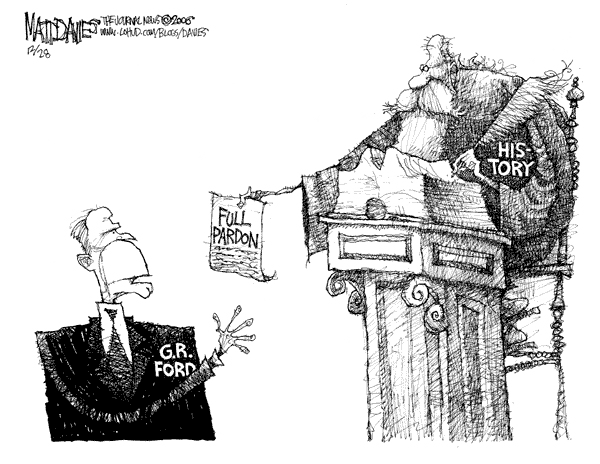
writers were quick to re-evaluate Ford’s abrupt decision to pardon his
predecessor, Richard Nixon, for wrongdoing over Watergate - the Post saying
that it was hard to see “how an indictment and trial would have done the
country much good”. The Wall Street Journal also stressed Ford’s personal
character, concluding that “history dealt him a weak hand; he played it
well”.
A weak hand is an
understatement: few US presidents have come into office overshadowed by the
burdens that Ford had to face immediately. He inherited an economy in the
mid-1970s that was sliding into recession and suffering from high inflation,
as the effects of Middle East oil price increases began to bite sharply. There
was the constitutional and political wreckage from Watergate and the Nixon
administration to be dealt with. And the embers of Vietnam were also still
smouldering. It was on Ford’s watch that the fall of Saigon took place with
that ignominious airlift evacuation from the roof of the US embassy*).
To have presided over any one of those national disasters would have scarred any administration. No wonder that Ford's time in office should, rather like that of John Major in Britain, have passed into the national conscience as hapless. That view was not helped by some of Ford’s televised stumbles**), such as his slip down wet steps when disembarking at Vienna airport, or his poor performance during the 1976 election campaign when he insisted, bizarrely, that Poland was not dominated by the Soviet Union. [...]
But as the nation’s obituarists were at pains to point out, the received image of Ford as clumsy was wide off the mark.
From: Richard Adams: Ford: from dimwit to man of
integrity. In: The Guardian Weekly, January 5-11, 2007. (abridged)
*)"ignominious airlift evacuation from the roof of the American embassy": a) photo
**)video, Ford stumbles http://de.youtube.com/watch?v=jlz0he9rtKw
video, Ford pardons Nixon http://de.youtube.com/watch?v=eM9dGr8ArR0&feature=related
CARTOONS: http://cagle.com/news/GeraldFord/main.asp
OBITUARY:
http://www.washingtonpost.com/wp-dyn/content/article/2006/12/27/AR2006122700528.html
EXTRA: JFK, Inauguration: http://de.youtube.com/watch?v=VB6hLg3PRbY&feature=related
back to Texterschließung WS 2008/2009, index back to homepage
THE BOTTOM LINE THE BOTTOM LINE THE BOTTOM LINE THE BOTTOM LINE THE BOTTOM LINE THE BOTTOM LINE THE BOTTOM LINE