SS 2005 Preuß Texterschließung: Klausur 05/07/05 (Staatsexamen Frühjahr 2003) text 12
On
the eve of St. George's Day 1993, the then Prime Minister, John Major*), had a
tricky speech to deliver. He needed to convince his party they could trust him
to defend the country when negotiating with the European Union. Party
discipline was already badly fraying, as an increasingly voluble right-wing
group refused to accept his assurances. The issue of Britain's relations with
the rest of Europe split the party from the top of the cabinet to the humblest
constituency association, with opinion getting increasingly 'anti-Europe' the
further you got towards the party's grassroots. Within four years, the
parliamentary party would be in more or less open warfare on the subject,
squabbling among themselves as the Conservative government spiralled out of
the sky to electoral oblivion in May 1997.
Major could sense all this. His own attitude to Europe suffered by comparison
with his right-wing critics, with their easy and scary slogans, because it was
essentially pragmatic, with little clear ideology. His beliefs, in the
sovereignty of nation states and the importance of free trade, were no
different from those of most of his party. But he was not prepared to demonize
the rest of the European Union, most of whose leaders he knew and respected.
What was he to do? This most English of men was a decent chap who ought to
have had an instinctive understanding of the worries of 'his' people. But he
had been trapped in the narrow world of Westminster politics for years. And he
had few rhetorical skills; a reporter who had seen him mount his soapbox
during the 1992 election campaign had described him as sounding, when he tried
to declaim, like some 'angry nerd in Woolworth's returning a faulty toaster'.
Much
of the speech could write itself. There would be a recital of the government's.
achievements, the usual credit-taking that is the small change of political
opportunism. There would be a lot of nonsense about the government's
determination to be 'at the heart of Europe' when so much of its behaviour made
it seem less like a heart and more like an appendix. There would be claims that
nothing in Britain's involvement in Europe endangered the country's sovereignty.
There would be the blunt suggestion that, frankly, the country had no
alternative. But he needed a peroration to end with and an image of Britain's
security to leave with his audience. What emerged was an extraordinary word
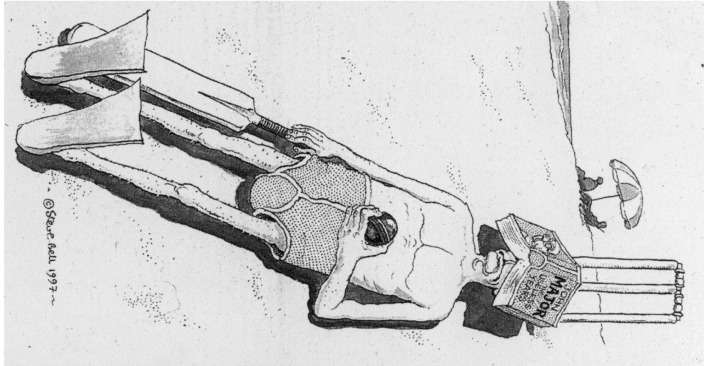
portrait. 'Fifty years from now,' he said, 'Britain will still be the country of
long shadows on cricket grounds, warm beer, invincible green suburbs, dog lovers
and - as George Orwell said - "old maids cycling to holy communion through
the morning mist".'
from: J. Paxman. The English. Portrait of a People. Penguin:
Harmondsworth 1999
*)
for
information on John Major go to: http://www.answers.com/topic/john-major#Wikipedia
Two links that will take you to Jeremy Paxman, as he mercilessly interviews British politicians:
http://news.bbc.co.uk/2/hi/uk_news/politics/vote_2005/blog/4519553.stm [BBC, video: Paxman interview] plus: transcript of interview
http://news.bbc.co.uk/1/hi/programmes/newsnight/newsnight_election_2005/4421655.stm [BBC video, 3 more Paxman interviews]
CARTOON: Steve Bell, The Guardian (1997)
for more cartoons by Steve Bell go to: http://www.guardian.co.uk/cartoons/archive/stevebell/0,7371,337764,00.html
back to Texterschließung SS 2005, index back to homepage
THE BOTTOM THE BOTTOM LINE THE BOTTOM LINE THE BOTTOM LINE THE BOTTOM LINE THE BOTTOM LINE THE BOTTOM LINE THE BOTTOM LINE