 Their Finest Hour by Winston Churchill
SS 2005 Preuß Texterschließung (Staatsexamen Herbst 1998) Text 1
He
died nearly 30 years ago, and it is more than half a century since his 'finest
hour'. But in death, as throughout most of his very long life, Winston
Churchill remains a figure of compelling fascination and unresolved controversy.
Two new biographies merely confirm that the jury on Churchill is still out.
Norman Rose's study is balanced, judicious and fair-minded: it recognises
Churchill's virtues, pays full attention to his shortcomings, and makes a
serious attempt to view him in historical perspective. By contrast, Clive
Ponting's much longer book is unashamedly the work of the prosecuting counsel.
It refuses to accept that Churchill was a great historical figure, finds fault
with everything he said or did, and regards him as a myth to be demolished
rather than as a man to be understood and assessed.
Ponting
is totally out of sympathy with his subject, with the result that his Churchill
emerges as a one-dimensional caricature: overwhelmingly ambitious, insufferably
self-centred, unpredictably inconsistent. He was an alcoholic, a racist, a
eugenicist and an elitist, and his marriage was more unhappy than successful. He
sought power only for personal gratification, and changed from one party to
another with cavalier indifference. Not surprisingly, his writings were one long
litany of self-justification, by turns economical with the truth and profligate
with falsehoods.
Rose is extremely good at bringing out the paradoxes of Churchill's character and career. He agrees with the verdicts of many contemporaries, who recognised Churchill's imagination, eloquence, industry and ability, but who also lamented his lack of judgment, wisdom and proportion. He notes that Churchill was often excessively belligerent in the Commons, yet regarded coalition governments as the best possible arrangement for running Britain's affairs. And he reminds us that for most of his life, Churchill was disliked and distrusted: only after 1940 was he acclaimed as 'the greatest Englishman of his time.' Rose's Churchill is a great man, with flaws and faults to match, the saviour of his country who was also the statesman in an era of decline.
David Cannadine, The foulest and the finest hour. A review of the following two books: A) Churchill, by Clive Ponting and B) Churchill, An Unruly Life, by Norman Rose. Published in The Observer, 1 May 1994 (abridged)
David Cannadine on Churchill (BBC Radio): http://news.bbc.co.uk/2/hi/programmes/the_westminster_hour/2787261.stm
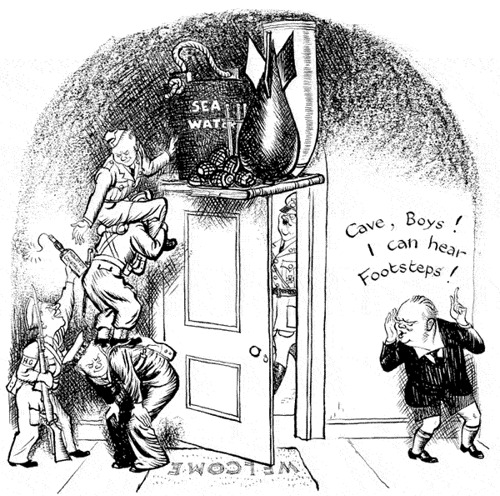
Cave,
Boys! I can hear footsteps!
(Cartoon by Leslie Gilbert Illingworth, September 13, 1940)
Their Finest Hour by Winston Churchill
back to Texterschließung SS 2005, index back to homepage
THE BOTTOM LINE THE BOTTOM LINE THE THE BOTTOM LINE THE BOTTOM LINE THE BOTTOM LINE THE BOTTOM LINE THE BOTTOM LINE