Over
four decades, Antony Sampson has watched democracy wither. Boyd Tonkin meets the
master anatomist of power.
*
23
April 2004 (From: The Independent, shortened)*
More than four decades into
his eagle-eyed scrutiny of power and wealth in Britain, Anthony Sampson can
still swoop on his prey at a speed that puts other journalistic sleuths to
shame. At the end of our interview in a Mayfair hotel, a ludicrously elongated
white stretch limo with smoked-glass windows draws up outside. Instantly,
Sampson jumps up to see who is getting out of it.
This time, for once, the quarry eludes him. It may well have been one of the
“populist tycoons” in leisure, services and showbiz who take centre stage
in his latest, sharpest and most radical “anatomy of Britain”, Who Runs
This Place?* This fresh elite of super-rich
anti-elitists emerges as the driving force of a country that shook off its old
deference to rank only to bow and scrape before the masters of the marketplace,
“a new Establishment, with greater resources and stronger bonds than the old
one - the bonds of money”.
Ever since the first Anatomy* in 1962, he
has sought with steely detachment to strip away the screens that surround
British power, whether erected (as then) by titled bankers in some Lombard
Street boardroom or (as now) by self-made TV moguls in a Covent Garden
restaurant.
On the political front, his latest quest coincided with an extraordinary - but
taxing - opportunity to see the new lie of the land. Late in the composition
of Who Runs This Place?,* the evidence
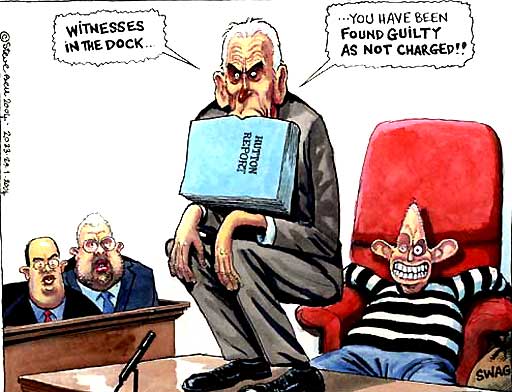
submitted to the Hutton inquiry1
(see
cartoon below!) lit
up the concealed pathways of power in Westminster and Whitehall “like a
flare in the night sky”: Showing all the pace and nous2
that writers half-a-century younger often lack, he quickly threaded the Hutton
revelations through the book to devastating effect. They confirm his diagnosis
that “decisions are actually taken by small groups of people, most of them
unelected and unaccountable”.
Sampson
explains that, although “one knew about the concentration of power in Number
10”, the Hutton disclosures acted “rather like the Watergate tapes. You had
this glimpse of the intensity, and almost the vulgarity, of power”.
His own trade comes in for quite a drubbing. The new ability among editors and
pundits to make and break (mostly break) careers elicits “fear and dislike”
in every other corridor of power. And with their new “destructive” potential
goes a very meagre appetite for self-control or self-criticism. As Sampson says:
”If you subjected journalists to the same kind of mocking analysis that’s
applied to politicians, there’d be nothing left. The whole profession would go
under.”
1 Reference to the Report of the Inquiry into the Circumstances Surrounding the Death of Dr David Kelly C.M.G. (published 28 January 2004)
2
(infml) = „Grips“, „Verstand“
* Nicht zu übersetzen.
(Die Quellenangabe ist nicht zu übersetzen! Bei der Fertigung der Reinschrift der Übersetzung für Korrekturzwecke jede zweite Zeile freilassen!)
THE BOTTOM LINE THE BOTTOM LINE THE BOTTOM LINE THE BOTTOM LINE THE BOTTOM LINE THE BOTTOM LINE THE BOTTOM LINE