
Shared
dystopias: George Orwell and Margaret Atwood
Orwell
and me
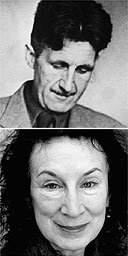
Margaret Atwood cried her eyes out when she first read Animal Farm at the age
of nine. Later, its author became a major influence on her writing. As the
centenary of George Orwell's birth approaches, she says he would have plenty to
say about the post-9/11 world
The
Guardian , Monday
June 16, 2003
|
|
|
I grew up with George Orwell. I was born in 1939, and
Animal Farm was published in 1945. Thus, I was able to read it at the age of
nine. It was lying around the house, and I mistook it for a book about talking
animals, sort of like Wind in the Willows. I knew nothing about the kind of
politics in the book - the child's version of politics then, just after the war,
consisted of the simple notion that Hitler was bad but dead.
So I gobbled up the adventures of Napoleon and Snowball,
the smart, greedy, upwardly mobile pigs, and Squealer the spin-doctor, and Boxer
the noble but thick-witted horse, and the easily led, slogan-chanting sheep,
without making any connection with historical events.
To say that I was horrified by this book is an
understatement. The fate of the farm animals was so grim, the pigs so mean and
mendacious and treacherous, the sheep so stupid. Children have a keen sense of
injustice, and this was the thing that upset me the most: the pigs were so
unjust. I cried my eyes out when Boxer the horse had an accident and was carted
off to be made into dog food, instead of being given the quiet corner of the
pasture he'd been promised.
The whole experience was deeply disturbing to me, but I
am forever grateful to Orwell for alerting me early to the danger flags I've
tried to watch out for since. In the world of Animal Farm, most speechifying and
public palaver is bullshit and instigated lying, and though many characters are
good-hearted and mean well, they can be frightened into closing their eyes to
what's really going on.
The pigs browbeat the others with ideology, then twist
that ideology to suit their own purposes: their language games were evident to
me even at that age. As Orwell taught, it isn't the labels - Christianity,
Socialism, Islam, Democracy, Two Legs Bad, Four Legs Good, the works - that are
definitive, but the acts done in their name.
I could see, too, how easily those who have toppled an
oppressive power take on its trappings and habits. Jean-Jacques Rousseau was
right to warn us that democracy is the hardest form of government to maintain;
Orwell knew that to the marrow of his bones, because he had seen it in action.
How quickly the precept "All Animals Are Equal"
is changed into "All Animals Are Equal, but Some Are More Equal Than Others".
What oily concern the pigs show for the welfare of the other animals, a concern
that disguises their contempt for those they are manipulating.
With what alacrity do they put on the once-despised
uniforms of the tyrannous humans they have overthrown, and learn to use their
whips. How self-righteously they justify their actions, helped by the verbal
web-spinning of Squealer, their nimble-tongued press agent, until all power is
in their trotters, pretence is no longer necessary, and they rule by naked
force.
A revolution often means only that: a revolving, a turn
of the wheel of fortune, by which those who were at the bottom mount to the top,
and assume the choice positions, crushing the former power-holders beneath them.
We should beware of all those who plaster the landscape with large portraits of
themselves, like the evil pig, Napoleon.
Animal Farm is one of the most spectacular
Emperor-Has-No-Clothes books of the 20th century, and it got George Orwell into
trouble. People who run counter to the current popular wisdom, who point out the
uncomfortably obvious, are likely to be strenuously baa-ed at by herds of angry
sheep. I didn't have all that figured out at the age of nine, of course - not in
any conscious way. But we learn the patterns of stories before we learn their
meanings, and Animal Farm has a very clear pattern.
Then along came Nineteen Eighty-Four, which was
published in 1949. Thus, I read it in paperback a couple of years later, when I
was in high school. Then I read it again, and again: it was right up there among
my favourite books, along with Wuthering Heights.
At the same time, I absorbed its two companions, Arthur
Koestler's Darkness At Noon and Aldous Huxley's Brave New World. I was keen on
all three of them, but I understood Darkness At Noon to be a tragedy about
events that had already happened, and Brave New World to be a satirical comedy,
with events that were unlikely to unfold in exactly that way. (Orgy-Porgy,
indeed.)
Nineteen Eighty-Four struck me as more realistic,
probably because Winston Smith was more like me - a skinny person who got tired
a lot and was subjected to physical education under chilly conditions (this was
a feature of my school) - and who was silently at odds with the ideas and the
manner of life proposed for him. (This may be one of the reasons
Nineteen-Eighty-Four is best read when you are an adolescent: most adolescents
feel like that.)
I sympathised particularly with Winston's desire to
write his forbidden thoughts down in a deliciously tempting, secret blank book:
I had not yet started to write, but I could see the attractions of it. I could
also see the dangers, because it's this scribbling of his - along with illicit
sex, another item with considerable allure for a teenager of the 50s - that gets
Winston into such a mess.
Animal Farm charts the progress of an idealistic
movement of liberation towards a totalitarian dictatorship headed by a despotic
tyrant; Nineteen Eighty-Four describes what it's like to live entirely within
such a system. Its hero, Winston, has only fragmentary memories of what life was
like before the present dreadful regime set in: he's an orphan, a child of the
collectivity. His father died in the war that has ushered in the repression, and
his mother has disappeared, leaving him with only the reproachful glance she
gave him as he betrayed her over a chocolate bar - a small betrayal that acts
both as the key to Winston's character and as a precursor to the many other
betrayals in the book.
The government of Airstrip One, Winston's "country",
is brutal. The constant surveillance, the impossibility of speaking frankly to
anyone, the looming, ominous figure of Big Brother, the regime's need for
enemies and wars - fictitious though both may be - which are used to terrify the
people and unite them in hatred, the mind-numbing slogans, the distortions of
language, the destruction of what has really happened by stuffing any record of
it down the Memory Hole - these made a deep impression on me. Let me re-state
that: they frightened the stuffing out of me. Orwell was writing a satire about
Stalin's Soviet Union, a place about which I knew very little at the age of 14,
but he did it so well that I could imagine such things happening anywhere.
There is no love interest in Animal Farm, but there is
in Nineteen Eighty-Four. Winston finds a soulmate in Julia; outwardly a devoted
Party fanatic, secretly a girl who enjoys sex and makeup and other spots of
decadence. But the two lovers are discovered, and Winston is tortured for
thought-crime - inner disloyalty to the regime.
He feels that if he can only remain faithful in his
heart to Julia, his soul will be saved - a romantic concept, though one we are
likely to endorse. But like all absolutist governments and religions, the Party
demands that every personal loyalty be sacrificed to it, and replaced with an
absolute loyalty to Big Brother.
Confronted with his worst fear in the dreaded Room 101,
where a nasty device involving a cage-full of starving rats can be fitted to the
eyes, Winston breaks: "Don't do it to me," he pleads, "do it to
Julia." (This sentence has become shorthand in our household for the
avoidance of onerous duties. Poor Julia - how hard we would make her life if she
actually existed. She'd have to be on a lot of panel discussions, for instance.)
After his betrayal of Julia, Winston becomes a handful
of malleable goo. He truly believes that two and two make five, and that he
loves Big Brother. Our last glimpse of him is sitting drink-sodden at an outdoor
cafe, knowing he's a dead man walking and having learned that Julia has betrayed
him, too, while he listens to a popular refrain: "Under the spreading
chestnut tree/ I sold you and you sold me ..."
Orwell has been accused of bitterness and pessimism -
of leaving us with a vision of the future in which the individual has no chance,
and where the brutal, totalitarian boot of the all-controlling Party will grind
into the human face, for ever.
But this view of Orwell is contradicted by the last
chapter in the book, an essay on Newspeak - the doublethink language concocted
by the regime. By expurgating all words that might be troublesome -
"bad" is no longer permitted, but becomes "double-plus-ungood"
- and by making other words mean the opposite of what they used to mean - the
place where people get tortured is the Ministry of Love, the building where the
past is destroyed is the Ministry of Information - the rulers of Airstrip One
wish to make it literally impossible for people to think straight. However, the
essay on Newspeak is written in standard English, in the third person, and in
the past tense, which can only mean that the regime has fallen, and that
language and individuality have survived. For whoever has written the essay on
Newspeak, the world of Nineteen Eighty-Four is over. Thus, it's my view that
Orwell had much more faith in the resilience of the human spirit than he's
usually been given credit for.
Orwell became a direct model for me much later in my
life - in the real 1984, the year in which I began writing a somewhat different
dystopia, The Handmaid's Tale. By that time I was 44, and I had learned enough
about real despotisms - through the reading of history, travel, and my
membership of Amnesty International - so that I didn't need to rely on Orwell
alone.
The majority of dystopias - Orwell's included - have
been written by men, and the point of view has been male. When women have
appeared in them, they have been either sexless automatons or rebels who have
defied the sex rules of the regime. They have acted as the temptresses of the
male protagonists, however welcome this temptation may be to the men themselves.
Thus Julia; thus the cami-knicker-wearing, orgy-porgy
seducer of the Savage in Brave New World; thus the subversive femme fatale of
Yevgeny Zamyatin's 1924 seminal classic, We. I wanted to try a dystopia from the
female point of view - the world according to Julia, as it were. However, this
does not make The Handmaid's Tale a "feminist dystopia", except
insofar as giving a woman a voice and an inner life will always be considered
"feminist" by those who think women ought not to have these things.
The 20th century could be seen as a race between two
versions of man-made hell - the jackbooted state totalitarianism of Orwell's
Nineteen Eight-Four, and the hedonistic ersatz paradise of Brave New World,
where absolutely everything is a consumer good and human beings are engineered
to be happy. With the fall of the Berlin Wall in 1989, it seemed for a time that
Brave New World had won - from henceforth, state control would be minimal, and
all we would have to do was go shopping and smile a lot, and wallow in pleasures,
popping a pill or two when depression set in.
But with 9/11, all that changed. Now it appears we face
the prospect of two contradictory dystopias at once - open markets, closed minds
- because state surveillance is back again with a vengeance. The torturer's
dreaded Room 101 has been with us for millennia. The dungeons of Rome, the
Inquisition, the Star Chamber, the Bastille, the proceedings of General Pinochet
and of the junta in Argentina - all have depended on secrecy and on the abuse of
power. Lots of countries have had their versions of it - their ways of silencing
troublesome dissent.
Democracies have traditionally defined themselves by,
among other things - openness and the rule of law. But now it seems that we in
the west are tacitly legitimising the methods of the darker human past, upgraded
technologically and sanctified to our own uses, of course. For the sake of
freedom, freedom must be renounced. To move us towards the improved world - the
utopia we're promised - dystopia must first hold sway.
It's a concept worthy of doublethink. It's also, in its
ordering of events, strangely Marxist. First the dictatorship of the proletariat,
in which lots of heads must roll; then the pie-in-the-sky classless society,
which oddly enough never materialises. Instead, we just get pigs with whips.
I often ask myself: what would George Orwell have to
say about it?
Quite a lot.